
Student Name
Capella University
EDD-FPX8020 The Dynamics of Organizational Improvement
Professor Name
Submission Date
Case Study: Riverbend
When healthcare delivery is combined with cultural differences and barriers to communication, organizations are often subjected to complex issues. Overcoming these obstacles is important since unresolved misunderstandings not only harm trust but also lead to poor patient outcomes and poor organizational performance. The framework of systems thinking, developed by Peter Senge, offers an approach toward the interpretation of the said dynamics in terms of core disciplines, organizational disabilities, and archetypes (Taylan and Weber, 2022). The case study of Riverbend will be analyzed in the following paper in terms of the concepts of Senge, the creation of a systems map, formulating critical questions to stakeholders, and practical recommendations to the Chief Executive Officer (CEO) to help the organization enhance cultural awareness and learning.
Case Synopsis
The Riverbend City Medical Center (RCMC) was struggling with a significant organizational conflict after a train derailment that put pressure on the hospital. In the crisis, the relationship between staff and the Vang family (who are part of the local Hmong community) became strained. The conflict was based on the lack of understanding of cultural practices, the barrier to communication, and distrust between hospital employees and patients. Things went wrong when the Free Press carried a humiliating story on the altercation that attracted negative publicity on how the hospital handled cross-cultural care. As CEO Eugene Pittman reacted, he started to consider options, such as a model in Merced, California, where medical practitioners wound up working with Hmong shamans to combine traditional practice with Western medicine. The case indicates a more profound systemic problem at RCMC: staff cultural incompetence, inadequate communication plans, and an unproactive attitude to establishing trust between minorities and the organization that eventually contributed to organizational conflict.
Cultural Misunderstandings and Communication Problems
Cultural misinterpretations and a lack of communication between the staff and the Hmong population led to organizational conflict at RCMC. Research reveals that a lack of cross-cultural communication in healthcare commonly results in mistrust in the patient, reduced compliance, and conflict escalation (Taylan & Weber, 2022). The above dynamism was reflected in the scenario whereby the staff was not able to identify the Hmong dependency on shamans and spiritual healing, as these practices were not categorized within Western medicine. Language barriers were another issue that favored the issue at hand because, without professional interpreters, there was a risk of misinterpretation of various situations to the families, which in this case included life-threatening issues. Research has shown that when healthcare providers embrace culturally competent practices and professional interpreter services, patient satisfaction, trust, and adherence to treatment are greatly increased, which reduces the chances of conflict and negative outcomes (Cipta et al., 2024). The gaps identified made Hmong patients seem to be noncompliant, and this contributed to the perception of the hospital as being dismissive and authoritarian. The derailment crisis combined tensions that were perceived, and a cycle of distrust was formed, which resulted in the establishment of perennial distrust on each side. Unless some cultural competence education and systematic communication strategies are established, RCMC will run the risk of reinforcing the failures, harming the care delivered to the patient, and further harming communication with the rest of the community.
A Systems Lens – The Four Core Disciplines
Personal Mastery
Staff at RCMC lacked personal mastery, which played a role in the poor management of cultural conflicts. Fateh et al. (2021) highlighted that personal mastery makes people constantly build self-awareness and align the growth of people with the purposes of the organization. At RCMC, employees exhibited minimal reflective and adaptive abilities in their engagement with Hmong patients. As an illustration, when there was conflict with the Vang family, the providers strictly imposed biomedical models without taking into consideration other healing practices or scrutinizing the weaknesses. The inability to be self-aware did not allow flexibility and empathy to emerge, aggravating the misunderstanding. Personal mastery might be encouraged by training on cultural competency, reflection, and ongoing education to assist staff to further align personal development with the hospital mission of delivering inclusive and patient-centered care.
Mental Models
The embedded mental models were also involved in the organizational conflict at RCMC by supporting stereotypical mental models as well as restricting teamwork. According to Petrie et al. (2023), mental models were defined as internal assumptions that process behaviors and make decisions, which may lead to blind spots. In RCMC, providers thought that Hmong practices were old-fashioned or even obsolete, and the community members believed that the hospital was arrogant and domineering. The assumptions identified were the source of mistrust and tension, especially during the derailment crisis, when staff did not blend traditional and Western medicine. By reforming the mental models using systems thinking, the providers would be able to recast cultural practices as assets instead of barriers and promote integrative care and decrease long-term conflict.
Team Learning
Team learning was also a problem in the hospital, and this hindered collective responsibility in responding to cultural issues. Petrie et al. (2023) assert that team learning is paramount to the ability of organizations to develop collective understanding and adjust to complex problems. In RCMC, staff did not have the opportunity to share worldviews and learn together due to siloed operations and lack of dialogue. The uncoordinated strategy led to responsive and inconsistent reactions to the crisis, which deteriorated the relationship with the Hmong community. It may further promote the greater capacity to tackle the cultural complexity by encouraging team learning through interdisciplinary dialogue sessions, staff workshops, and joint community forums that would make the hospital more unified and resilient.
Shared Vision
Lastly, lack of collective vision for cultural inclusiveness undermined organizational unity at RCMC. Kaiser et al. (2021) were of the opinion that a shared vision brings about clarity of purpose and harmonizes the stakeholders in regard to shared objectives. The vision of the hospital was extremely limited to Western standards of medicine and did not include the values of the varied population of patients. This kind of non-inclusiveness pushed the Hmong community away and left staff members without a definite model of culturally responsive care. Consequently, employees found it hard to understand how the roles would help to build trust with patients. It is possible to establish a common vision, which would embrace cultural respect and medical excellence to bring staff and community members together and allow them to collaborate, encouraging systemic changes in communication and care delivery.
A Systems Lens – Organizational Disabilities and Systems Archetypes
RCMC organizational disabilities contributed greatly to the war with the Hmong people. A disability that can be seen in the case is the psychological attitude that the enemy is out there and blame is thrown outwards instead of inwardly being seen as a contributor to the issue. It has been demonstrated that when externalizing blame, organizations cannot recognize the systemic weaknesses and thus cannot solve the problems in a meaningful manner (Hariyani et al., 2024). In RCMC, the conflict was perceived by the staff as a result of Hmong noncompliance instead of the hospital not having cultural competency and not practicing cultural competence. This attitude nurtured insecurity, and the staff could not analyze their contribution to the brewing distrust. One other impairment, the I am my position, was also in play since the staff members worked within the boundaries of the team without giving attention to the larger organization. As an illustration, there was no active engagement of interpreters, and no team took the issue of mediating between cultures. The specified disabilities supported the culture of isolated accountability and blame game, prohibiting learning and sustainable problem-solving.
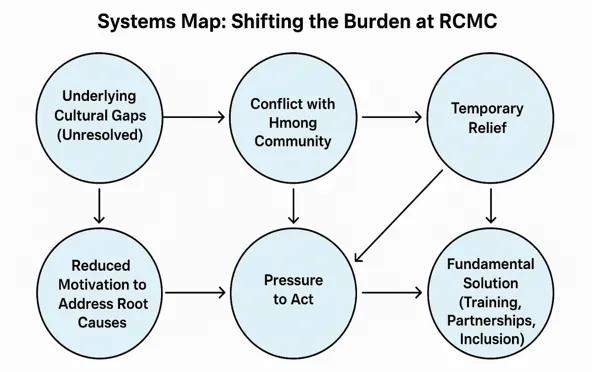
The systems archetype that is evident in the case is the one of shifting the burden. The archetype identified occurs when organizations are interested in short-term solutions instead of dealing with the underlying causes. A study of healthcare organizations indicates that the use of instant solutions, like apologies or reputation management, is likely to have a short-term impact but further cements mistrust patterns (Tarnanen et al., 2021). In the case of the RCMC hospital, the immediate reaction of the hospital to the free press article was to fix reputational damage and seek external remedies like checking out the model of Merced, instead of looking within to work out communication and cultural differences. Short-term solutions such as issuing apologies or PR management were only a temporary solution to the pressure outside; however, the issue of cultural misunderstanding was not addressed. The basic resolution, establishing long-term relationships with cultural competency training, enhanced interpreter services, and collaboration with community authorities, was disregarded since the solution was more organizational in nature.
The issue is illustrated with the help of a systems map, which is provided below in the figure of the identified archetype. The symptomatic solution cycle indicates how RCMC reacted to conflict with expedient interventions like apologies, which lessened what was being said outside. Systems thinking academics hold the position that dependency on symptomatic remedies leads to a lack of incentive to make systemic changes, which form a vicious cycle of dependence (Hariyani et al., 2024). The point at RCMC manifested itself in the repetitive nature of response to crisis in reactive mode rather than proactive establishment of long-term cultural strategies. The path not chosen is the basic solution loop of investments in cultural competence, staff training, and inclusive policies, which would slowly eliminate conflicts and create a trusting community. Instead of fixing the root causes of the issues, RCMC focused on alleviating the symptoms, which caused the cycle to repeat, leading to crises in the organization relying on short-term fixes instead of sustainable learning.
Question
- What are the assumptions that staff have in regard to Hmong health practices, and how do these beliefs affect the perception of patient compliance?
- What impacts language barriers on care delivery, and what resources do we need to enhance interpretation services?
- What practices would engage Hmong leaders or shamans in the planning of care to enhance trust and cooperation?
- What are organizational practices, e.g., cultural competency training or policy changes, that are needed to avert future crisis?
- What is needed to ensure that leadership can measure the effectiveness of the cultural competency initiatives and that they improve organizational learning continuously?
Opening specific questions will help stakeholders to identify assumptions and cultural biases under the surface that may stop organizational learning. Tarnanen et al. (2021) highlighted that untested mental models can usually restrain innovation and reinforce systemic conflict. Debunking the myth about Hmong traditions will help leaders get past the stereotypes and come closer to respecting each other. Language-related questions help reveal systemic weaknesses in interpretation services, a crucial factor in effective healthcare communication (Taylan & Weber, 2022). Engaging community leaders in inquiry is a systems thinking strategy with the ability to appreciate collaboration and joint ownership of solutions. Studies indicate that the development of cultural awareness and proper communication can greatly enhance patient confidence and health outcomes in all forms of populations (Taylan & Weber, 2022). Lastly, inquiries regarding long-term organizational culture enhance sustaining cultural competence as opposed to fixes in the short term.
Practical Recommendations
To accommodate both long and short-term change in the organization, the CEO of RCMC should adopt a multi-layered approach that should consider both long and short-term change. Firstly, an effort to use structured cultural competency training for all personnel is required. Training on Hmong health beliefs and stereotyping would increase the level of awareness and lead to respectful communication. The articles indicate that cultural competence can directly result in higher levels of trust and patient outcomes in the multicultural health care setting (Hariyani et al., 2024). Second, the hospital needs to increase the number of interpreter services by hiring and training bilingual employees as well as investing in certified medical interpreters. The mentioned measure will target the challenges to systemic communication and will avoid the disadvantage of families when critical medical discussions are being held (Taylan & Weber, 2022). Third, in the Merced model, establishing coalitions with Hmong leaders and shamans would be needed to create trust and establish a bridge between Western medicine and traditional medicine. By introducing the officialization of the collaborative roles, the hospital is demonstrating respect towards cultural customs, as well as enhancing adherence to medical care. In the long run, with the last option, the CEO should establish a community advisory board, including representatives of minorities. This platform would ensure that there is continuous discussion, a joint decision, as well as constant feedback (Tarnanen et al., 2021). The discussed collaborative approaches are amenable to a systems thinking approach since they emphasize the root causes rather than quick fixes, which ultimately enhances care delivery and engagement with the community.
Conclusion
The Riverbend scenario illustrates how cultural misinterpretations and communication obstacles may progress to organizational conflict in a situation where no action is taken to deal with the issue. Application of the disciplines by Senge displays the need to challenge mental models, establish a common vision, facilitate personal mastery, and strengthen team learning to encourage systemic change. Such organizational diseases as blame-shifting and siloed accountability and the archetype of Shifting the Burden also reveal why the new-fangled solutions were not used to resolve the underlying issues in the short term. To restore trust and enhance patient outcomes, the RCMC should consider culturally responsive practice, specify the quality of the interpreter services, and collaborate with the Hmong community leaders. A systems thinking approach is the most sustainable way to go, and marries organizational learning to the needs of the community.