

EDD FPX 8010 Assessment 3 Strategic Plan Development
Student Name
Capella University
EDD FPX 8010
Professor Name
Submission Date
Strategic Plan Development
Developing a strategic plan is essential to make significant improvements in the existing healthcare services. Strategic planning will assist the hospital management in enhancing the level of quality of care, which will eventually result in patient trust and satisfaction. The behavioral health department of Albany Medical Center will be given the strategic plan and departmental priorities in the assessment. Also, the significance of the organizational policies in developing the strategic priorities is provided. The congruence of the behavioral health department with the general strategic plan of the hospital will be discussed based on the balanced scorecard (Albany Medical Center, n.d.). The Albany Medical Center’s mission is to meet the healthcare needs of the community by expanding healthcare services through the community health improvement plan.
Departmental Strategic Priorities
The Albany Medical Center behavioral health department came up with strategic priorities to enhance the accessibility of behavioral and mental health services in the community. The first strategic priority is to expand the community’s access to cost-effective behavioral services to enhance community access to services (Albany Medical Center, n.d.). To provide cost-effective services to the community, an initial investment is necessary. Allocation of resources for expanding behavioral healthcare services helped in attracting more patients, improving the financial stability of the department. The second strategic area is to lower the time it takes to wait after patients have been scheduled by simplifying the scheduling process (Albany Medical Center, n.d.). Within the behavioral department, as a measure to cut down on the wait time, one of the technologies that will be employed includes telehealth-based services that will be used to provide remote care to the patients, hence cutting the time taken to wait.
The third departmental strategic priority is to ensure that the behavioral department develops a culture of interprofessional collaboration that will help provide the patients with effective care. The hospital staff, such as the mental health personnel, pharmacists, nursing staff, and information technology staff, will work together to offer remote care to the patients. Interprofessional collaboration between the staff helps in delivering effective care to patients, improving health outcomes (Wei et al., 2020). The fourth strategic priority of the behavioral department is the introduction of a cultural competency training program to the healthcare staff, especially the mental healthcare professional (Albany Medical Center, n.d.). The training will enable the staff members to deliver care services with consideration of the cultural beliefs of the patient to increase trust and satisfaction with behavioral healthcare services.
The departmental priorities are the possible and significant ones to enhance the above standards of care quality of the behavioral department at the hospital. The developed priorities underscore the need for resources to deliver effective behavioral care to patients that are synchronized with the availability of the resources allocated for the department. Further, the priorities also mirror the congruence with the objectives of the hospital to promote excellent care to increase patient satisfaction and trust (Albany Medical Center, n.d.). Moreover, the opportunity for enhancement by leveraging the technology and conducting the staff training program also showed the department’s commitment to enhancing the quality of care. The priorities are significant, therefore, because of the compatibility with the strategic plan of the hospital to increase the quality of care and patient satisfaction.
Organizational Policies
Policies in organizations create regulations that assist and guide the normal functioning of the behavioral department of Albany Medical Center. The behavioral department underscores the need for equitable delivery of behavioral services to the community to develop people’s trust in the services. One of the policies that enables the operations of the behavioral department is resource allocation. The resources allocated to the expansion of behavioral care will help deliver fair care to patients with behavioral problems, making health outcomes and quality of life better (Miller et al., 2023). The interprofessional coalition is another policy that helps the department to proceed with the operation and provide effective care to patients. The healthcare staff, specifically mental health professionals, nursing staff, and pharmacists, join forces to come up with a coordinated care plan to achieve better health outcomes when it comes to managing behavioral issues (Reist et al., 2022). The collaboration aided in delivering effective care to patients and increased patient trust and satisfaction.
Some of the policies that negatively affect the usual operations of the behavioral department are the rigorous hierarchical structure. Policies that give preference to the hierarchical system are counterproductive to the functioning of the behavioral department. The hierarchical structure delays the decision-making process and does not allow implementing quality improvement measures (Fernandopulle, 2021). Therefore, the behavioral department encounters obstacles to establishing new programs to enhance the quality of care. Additionally, the policy for change in practices also brings barriers for the department due to budget constraints (Wang et al., 2023). The change in practices is needed after a few years to improve the quality of care. Nevertheless, the conflicting interests with the rest of the departments introduce financial limitations that limit the department in achieving the target goal.
Implications and Consequences
There is a need to understand the implications and the effects of policies on the performance of the department. For example, resource allocation and collaborative care policies have positive implications on the behavioral department. Proper resource allocation will help the department to enhance and change the quality of care and eventually increase patient trust and satisfaction (Miller et al., 2023). Moreover, the promotion of a collaborative practice of care improves the level of care quality. The effects of the policies are an increase in patient trust and satisfaction through the provision of efficient behavioral health care services.
Policies that limit the department’s function, such as hierarchical system policy and changes in practices, have negative implications and outcomes. With a hierarchical system, the department is unable to enhance its functionality because of the delayed decision which impacts department functions and productivity (Wang et al., 2023). Additionally, the change in practices brings competing interests between the different departments that also affect the function of the behavioral unit. Poor health outcomes and diminished patient trust are just some of the adverse consequences of policies.
Aligning Departmental Strategic Priorities
Behavioral departmental strategic priorities aim at enhancing the quality care standards that are in tandem with the Albany Medical Center priorities. To begin with, the strategic priority of the department is to deliver cost-effective care services through increased provision of the already available healthcare services that fall under the financial aspect of the balanced scorecard. The departmental strategic priority, therefore, suits the strategic plan of Albany Medical Center to take advantage of technology to deliver behavioral care to society (Albany Medical Center, n.d.). Secondly, the departmental strategic priority will be to streamline the process of scheduling appointments to reduce the waiting time and improve customer satisfaction, taking into account the customer component of a balanced scorecard (Albany Medical Center, n.d.). Adhering to the hospital’s strategic plan, the behavioral department also has a strategic priority to use technology for delivering behavioral care that lowers the wait time for patients.
The hospital and departmental priorities are also aligned in the aspect of the internal process. As a strategic approach, the behavioral department is dedicated to establishing interprofessional cooperation between the mental healthcare staff, pharmacists, and the nursing staff to provide effective behavioral care to the patients. The urgency highlights the necessity of altering internal operations that are in line with the strategic plan of the hospital in promoting the culture of coordinated care. With regard to the learning and growth aspect of a balanced scorecard, the departmental strategic focus will be to undertake a cultural competency training program for the healthcare staff members ( Albany Medical Center, n.d.).
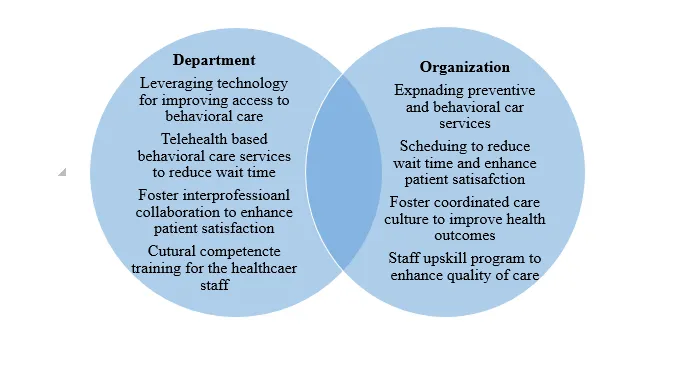
The training will assist the staff to provide effective behavioral care to patients, taking the cultural beliefs of the patients into consideration. Likewise, the hospital’s strategic priority also focuses on implementing the staff upskilling program to improve the quality of care. The concordance of the departmental and hospital strategic priorities presented information on how to enhance the quality of care in general (Albany Medical Center, n.d.). In Appendix A, a graphical illustration of the congruence between the strategic priorities of the department and the hospital is included.
Conclusion
The behavioral department of Albany Medical Center is created, and a strategic plan is made. The balanced scorecard is taken into account when developing the strategic priorities. The department’s strategic plan is to enhance accessibility of the community to behavioral and mental health services. These priorities provide a structured direction for the department’s ongoing efforts to support community health needs. The organizational policies also aid and restrict the normal activities of the behavioral department. Hence, the implication of policies on the performance of the department needs to be addressed. Moreover, the behavioral department’s strategic priorities align with the Albany Medical Center’s priorities that focus on providing effective care services to the community.
References
Albany Medical Center. (n.d.). Coalition completing assessment and plan on behalf of participating counties/hospitals Healthy Capital District Initiative. Albanymed.org. https://www.albanymed.org/wp-content/uploads/sites/2/2023/10/Community-Health-Needs-Assessment-and-Community-Service-Plan_2022-2024.pdf
Fernandopulle, N. (2021). To what extent does hierarchical leadership affect healthcare outcomes? Medical Journal of the Islamic Republic of Iran, 35(117). https://doi.org/10.47176/mjiri.35.117
Miller, S. J., Sly, J. R., Alcaraz, K. I., Ashing, K., Christy, S. M., Gonzalez, B., Lu, Q., Newton, R. L., Redmond, M., Shen, M., Purcell, K., Yi, J., Veinot, T., & Meade, C. D. (2023). Equity and behavioral digital health interventions: Strategies to improve benefit and reach. Translational Behavioral Medicine, 13(6), 400–405. https://doi.org/10.1093/tbm/ibad010
Reist, C., Petiwala, I., Latimer, J., Raffaelli, S. B., Chiang, M., Eisenberg, D., & Campbell, S. (2022). Collaborative mental health care: A narrative review. Medicine, 101(52), e32554. https://doi.org/10.1097/md.0000000000032554
Wang, T., Tan, J. Y., Liu, X. L., & Zhao, I. (2023). Barriers and enablers to implementing clinical practice guidelines in primary care: An overview of systematic reviews. British Medical Journal Open, 13(1), e062158. https://doi.org/10.1136/bmjopen-2022-062158
Wei, H., Corbett, R. W., Ray, J., & Wei, T. L. (2020). A culture of caring: the essence of healthcare interprofessional collaboration. Journal of Interprofessional Care, 34(3), 1–8. https://doi.org/10.1080/13561820.2019.1641476
Appendix for
EDD FPX 8010 Assessment 3
Appendix A
Visual Representation of Alignment Between Strategic Priorities
Appendix B
Balanced Scorecard for a Department
Domain | Objectives | Performance Metric | Benchmark Target | Initiatives |
Financial | Improving financial stability by attracting more patients | Revenue | Increase revenue by 12% in the next year | Implementing technology to deliver cost-effective remote care services. |
Customer | Leveraging technology to deliver healthcare services | Patient satisfaction score | Enhancing the patient satisfaction score to 90% | Using telehealth to deliver behavioral care remotely |
Internal process | Coordinated care to provide timely care. | Patient wait time | Lowering the patient wait time from one week to one day | Fostering a coordinated care culture |
Learning and Growth | Enhancing the staff expertise for providing evidence-based care | Staff turnover rate | Reduce the turnover by 15% | Staff cultural competency training program. |