

Applied Improvement Project Action Plan
Learner Name | |
Learner E-mail | |
Learner ID Number | |
Instructor Name | |
Specialization | EdD, Performance Improvement Leadership |
Program Director Name | |
Program Director E-mail | |
Name of Project Site | |
Name of Person Giving Authorization to use Site | |
Type of Organization | Secure juvenile detention organization serving detained youth |
Learner Role at Site | Intake Supervisor |
PROVISIONAL APPROVAL BY INSTRUCTOR Name & Date | |
Date of IRB APPROVAL |
Introduction
The aim of this Applied Improvement Project (AIP) is to put into practice and assess a trauma-informed intervention based on rehearsals spanning four weeks to enhance the performance of the staff in the application of the protocols for modifying behavior at the site of this project. It is designed to enhance fidelity in the implementation process, achieve congruity in the responses of the personnel, and address the issue of practice that emerged within the organization. The project is currently in the beginning stage of the AIP process since it is now devised according to the requirements of the Action Plan, which implies the stage when the intervention is developed in accordance with the questions put forward by the guiding ones, as well as with the plan for the intervention implementation, data gathering, and evaluation.
The AIP Model provides an organized approach to solving organizational issues utilizing a systematic investigation and a gradual advance. As depicted in Figure 1, the model comprises three interrelated steps: planning, implementing, and evaluating. These phases assist students in discovering an issue of principle, developing and implementing evidence-based solutions, assessing results, thinking over conclusions, and disseminating results. In the course of Advanced Doctoral Courses, learners focus on different elements of the AIP Model in each course and work their way toward creating a complete AIP.
Figure 1
Applied Improvement Project Model
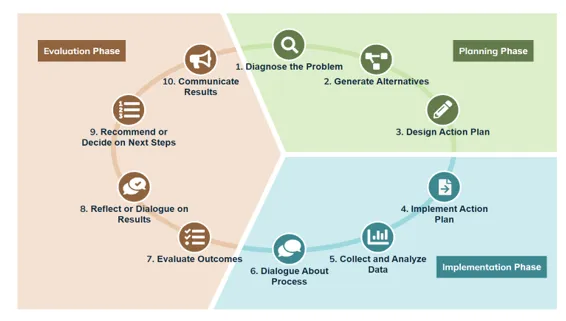
Note. The illustration depicts the essential aspects of the Applied Improvement Project Model along with a summary of its operations through the Advanced Doctorate programs. The shaded parts highlight the significant stages in the model, while the round logos represent the 10 different steps executed. The segment between them indicates their relationship during the implementation phase.
The current problem is that staff are inconsistent in their application of behavior intervention protocols with the youth. This inconsistency results in increased behavioral incidents, as well as less instructional time and less adherence to trauma-informed practices. Furthermore, root cause analysis identified the lack of opportunities for continued practice and receiving feedback on performance after the training sessions as an important contributing factor to the issue. The plan to resolve the issue involves the implementation of a four-week-long trauma-informed professional development intervention based on rehearsals that includes modeling, guided practice, role play, and structured feedback to ensure consistency in implementing behavior intervention protocols for the facility staff.
Purpose of the Project
The goal of AIP is to execute and assess a four-week rehearsal-centered trauma-informed professional development intervention, aiming to increase the effectiveness of protocol implementation among staff members at the site of the project. This increase in effectiveness will help improve the fidelity of the organization to trauma-informed behavior intervention methods. The project is also expected to cut down on variability in staff responses in interactions with youth and improve continuity in operations across the intake, education, and security units.
The objectives of this project are related to the problem of practice that has been established, which is that behavior protocols are not applied properly by the staff at all units. In turn, the lack of proper implementation leads to more behavioral incidents and less instructional time, in addition to a decline in the fidelity of the organization in terms of the use of trauma-informed practices. This project aims to challenge one of the root causes found during the needs assessment, which became evident in the form of a lack of chances for performance feedback and practice after the training.
Participants and Stakeholders
Participants
There will be around five to eight personnel from intake, education, and security departments at the project site involved in the experiment. These personnel will be in charge of conducting behavior modification projects when adolescents are going through the intake process, training programs, housing activities, and transition to different areas of the facility. All personnel involved in the experiment will take part in the four-week intervention training and will be carrying out acts of modeling, practical exercises, role-playing, training for mastering new techniques, checks for the skills learned, monitoring of fidelity, keeping records of their work, and post-intervention interviews. The data received will be applied for evaluation of the intervention.
By employing purposeful sampling, the participant group will be chosen because these employees have a direct background in using approaches for behavior intervention and are well acquainted with the given issue. Representatives will be invited from all relevant spheres, such as intake, education, and security. In total, five to eight people are appropriate for this kind of qualitative AIP, for this will give enough material for investigation of their reports but will not allow having too many respondents (Creswell & Poth, 2018). The participants should not be the students’ subordinates in order to exclude coercion and facilitate the ethical participation of the respondents.
Stakeholders
Key players in this AIP would be facility administration, unit supervisors, training staff, intake staff, security staff, the personnel involved in mental health, and the youth in custody at the Harris County Juvenile Justice Center. The facility management will be playing the role of stakeholders since it will be approving this project, providing the facilities to execute it, and also ensuring that the needed intervention is done according to the goals set by the organization and trauma-informed practices.
The supervisors will be supporting the implementation of this project by facilitating the staff involvement process as well as the utilization of interventions in their units. The staff involved in education, intake, and security are indeed involved in this project, as better consistency in use of the interventions would lead to better education and training, as well as supervision of the youth. The people working in mental health sphere may also be considered stakeholders because successful implementation of the trauma-informed approach in behavior therapy would positively amplify the needs of the youth in terms of regulation of their emotions.
Description of the Applied Improvement Project
Following organizational approval and participant recruitment, participants will engage in baseline activities (pre-intervention self-assessment) and then participate in eight 90-minute weekly professional development sessions. These sessions will follow the model-practice-feedback format that will include a presentation of the trauma-informed behavioral intervention strategy by the facilitator, modeling how it should be used in the scenarios typical for secure juvenile detention, engaging participants in role-plays, and giving structured feedback based on a fidelity checklist. Intervention components are taught gradually in four weeks in order to teach participants how to reach fidelity of implementation and use the intervention in real practice.
Implementing the project will require approval by organizational leadership, as well as the release time for participants, training space, presentation materials, procedural documents, participant materials, role-playing exercises, fidelity checklists, documentation templates, and data collection materials. The coordinator will be responsible for conducting all professional development sessions, organizing the implementation of the project, collecting information for the project, keeping the implementation materials, and noting all observations that take place during the implementation process.
The value of the project will be based on increased fidelity of the implementation of the behavior intervention procedure across different departments. Higher fidelity of the procedure implemented will enhance the chances of using a more trauma-informed approach to staff actions, improve the practices of documenting events by the staff, improve behavior management habits, and enhance continuity between different programs. All data about the project value will be collected using fidelity checklist, notes of the facilitator, skill check tasks, documentation of practices of participants, journals of reflections of participants, and interviews conducted after the implementation (Costa et al., 2023). This information will help to assess the fidelity and confidence of the project implementation by the staff.
Implementation Plan
At the project site, the issue of practice that was pinpointed includes unequal application of behavior intervention protocols between intake, instructional and security divisions of departments. Such discrepancies lead to increased rates of behavioral problems, decrease of teaching time and low fidelity of the use of knowledge about trauma. One of the root causes found in the approved need assessment is poor opportunities for practicing and receiving feedback after the training course.
Thus, different staff ended up applying behavior intervention protocols differently. The officials in the organization, supervisors at the unit and the learner developed the plan on how to solve the defined problem of practice. The intervention selected is a kind of training program based on a four-week procedure called trauma-informed professional training which is aimed at improving fidelity of the implementation through applying modeling, guided practice and role-playing. The detailed program of implementation can be seen in Table one, where the activities, people, terms, and deadlines are formulated.
Table 1
Implementation Plan
Activity/intervention | Tasks | Who | Timeline | Deadline | Evidence of completion (outputs) |
Obtain organizational approval | Obtain site approval, confirm project schedule, recruit participants, distribute informed consent | Applied Researcher, Organizational leadership | Week 0 | Before implementation | Approval documentation, participant list, signed consent forms |
Baseline data collection | Administer demographic questionnaire and pre-intervention self-assessment | Applied Researcher, Participants | Beginning of Week 1 | Prior to Session 1 | Completed questionnaires and self-assessments |
Professional development intervention | Conduct two 90-minute rehearsal-based trauma-informed professional development sessions focusing on de-escalation strategies using modeling, guided practice, role-play, and fidelity feedback | Applied Researcher, Participants | Week 1 | End of Week 1 | Attendance records, fidelity checklists, facilitator notes |
Professional development intervention | Conduct two sessions emphasizing transition routines and behavior intervention protocols across operational units | Applied Researcher, Participants | Week 2 | End of Week 2 | Attendance records, fidelity checklists, participant practice activities |
Professional development intervention | Conduct two sessions focusing on consistent behavior-response procedures and implementation fidelity | Applied Researcher, Participants | Week 3 | End of Week 3 | Skill-check activities, fidelity checklists, observation notes |
Professional development intervention | Conduct two sessions addressing documentation practices, transfer of learning, and sustainability planning | Applied Researcher, Participants | Week 4 | End of Week 4 | Documentation practice tasks, reflection journals, attendance records |
Post-intervention data collection | Conduct post-intervention self-assessments and interviews; collect all project documentation | Applied Researcher, Participants | Week 5 | End of implementation | Completed interviews, self-assessments, final project data |
The participants will take active part in the process of implementation of the program through attending professional development seminars based on rehearsal activities, performing practice tasks, discussing important issues, and reflecting through follow-up interviews. The implementation assistance will be given by organizational leadership and unit supervisors, who will give time-off for program participation and supervise the organizing process. As a result of continuous work with all stakeholders the implementation will be successful and organizational support for sustaining the intervention will be created.
During the implementation process, participants and stakeholders will be provided with regular information updates by means of agenda meetings, email, and end-of-week feedback. The information exchanged will include the agenda of forthcoming meetings, requirements for programs, and deadlines. Some possible problems arise from scheduling issues, availability of participants, and their workloads, and will be solved through pre-scheduling and working with the organizational leaders.
Planning Questions
- How will participants’ release time be organized, so that they can attend all eight sessions on professional development?
- How will absences in one or more training sessions be managed?
- What support will be provided to ensure the sustainability of the intervention for the organization after the initial action cycle?
- What steps will be taken to keep participants’ data private throughout the project?
Guiding Questions
The overall concept of guiding questions provides some kind of a reference point for assessing both how the intervention was conducted and what results were obtained. Process guiding questions are more about the “how” aspect of the four-week (and based on rehearsals) trauma-informed professional development, hence involving the implementation process and how the participants apply the lessons learned throughout this timeframe, despite of possible differences from time to time.
Meanwhile, outcome guiding questions are centered on the actual measure of help that the intervention brings for the staff’s implementation of the desired behavior intervention protocols. Because in some way outcome guiding questions are concerned with how the participants perceive usefulness of the intervention itself as well. Keeping in mind everything mentioned above, these sets of questions will help with the collection and analysis of the data, helping to figure out whether the process really took place in the way it was supposed to be executed and whether it has successfully resolved the issue of practice defined in the beginning.
Process Guiding Questions
- What behavior intervention practices have participants put to use in their work settings?
- How do participants describe their involvement in the modeling, practice, simulation, and feedback sessions of the professional development intervention?
Outcome Guiding Questions
- What role did the professional development intervention play in making participants consistent and confident at using behavior intervention protocols?
- To what extent do participants think that the professional development intervention helped them improve their implementation fidelity?
Data Collection Plan
The data gathering plan elaborates the evidence sources and the methods to be used to evaluate the success and results of the Applied Improvement Project. All data sources are selected in accordance with the project’s guiding questions and will be used to gather information before, during, and after the four weeks of the trauma-informed professional development training based on rehearsals as a teaching method. In Table 2, there is information about the kinds of collected data, the timing and sources of data collection activities, as well as the type of data collected (process or outcome).
Table 2
Data Collection Plan
Guiding Question (Process & Outcome) | Type of Data to be Collected | Data Source | When Collected | Process or Outcome |
How will the four-week rehearsal-based trauma-informed professional development intervention prepare participants to implement behavior intervention protocols consistently across operational settings? | AIP Implementation Journal (Qualitative) Interviews (Qualitative | Applied researcher Participants | Throughout the intervention After the intevention | P |
How will participants implement the behavior intervention strategies learned during the intervention in their daily practice? | AIP Implementation Journal (Qualitative) Interviews (Qualitative | Applied researcher Participants | Throughout the intervention After the intevention | P |
How will participants describe their experiences with the modeling, guided practice, role-play, and feedback components of the intervention? | AIP Implementation Journal (Qualitative) Interviews (Qualitative | Applied researcher Participants | Throughout the intervention After the intevention | P |
In what ways are participants implementing the behavior intervention strategies following the intervention? | AIP Implementation Journal (Qualitative) Interviews (Qualitative | Applied researcher Participants | Throughout the intervention After the intevention | O |
In what ways did the intervention improve participants’ consistency and confidence in implementing behavior intervention protocols? | AIP Implementation Journal (Qualitative) Interviews (Qualitative | Applied researcher Participants | Throughout the intervention After the intevention | O |
In what ways do participants perceive the professional development intervention as contributing to improved implementation fidelity of behavior intervention protocols? | AIP Implementation Journal (Qualitative) Interviews (Qualitative | Applied researcher Participants | Throughout the intervention After the intevention | O |
Data will be gathered prior to, during, and after the four-week rehearsal-based trauma-informed professional development intervention. Before the intervention, participants will be asked to complete the pre-intervention self-assessment so that we can understand the baseline level of their confidence in implementing behavior modification protocols. While the intervention is ongoing, participants will be provided with fidelity checklists in each professional development session, which will help us track the implementation of the intervention strategies. In addition, participants will maintain the AIP Implementation Journal that will help them track any implementation activities they carry out and any observations they might have during the duration of this project.
After the intervention is concluded, participants will be required to take part in a post-intervention self-assessment and will also participate in individual semi-structured interviews. The interviews will allow the participants to narrate their experience with the intervention, discuss how they implemented the techniques, and highlight both strengths and weaknesses. Collecting data before, during, and after the implementation of the intervention will create enough evidence to assess the implementation and the result of the intervention based on the research questions of this project.
Qualitative Data Collection Instruments
Qualitative data shall be collected to evaluate the implementation of the four-week rehearsal-based trauma-informed training as well as its outcomes. A variety of qualitative data sources will be utilized to learn about the experience of the participants, compliance with the intervention, and views about it. The sources of qualitative data will include semi-structured interviews, AIP Implementation Journal, fidelity checklists, and participant reflection journals. All these data sources will provide the answers to the process and outcome guiding questions of the project and will serve as a tool for assessing the implementation and outcomes of the intervention.
Interview
After 4 weeks of intervention, all participants will be interviewed through semi-structured interviews in order to understand how they feel about their experience and how they perceive the professional development. They will be invited for an individual interview in the private meeting room on the site of the project or in any other mutually agreed place, which will take approximately 30-45 minutes.
Informed consent will be read to the participants prior to conducting the interview, therefore they will be reminded that they take part in this research on voluntary basis and they have the right to refuse from giving the answer to any question or stop taking part in the interview at any point. Each interview will be conducted in audio recordings (with the permission of the participant), so as to assure proper transcription of all the interviews conducted by the researcher. The audio recording information will be stored on the password-protected computer. Consequently, all identification information will be deleted in order to provide confidentiality for interview participants.
AIP Implementation Journal
At every stage of the process, the learner will complete an Implementation Journal pertaining to their AIP. The entries will be made right after the professional development sessions and will summarize the details of the implementation process.
Data Analysis Plan
This data analysis plan outlines the approaches that will be executed for organizing, analyzing and processing qualitative data acquired during the Applied Improvement Project. The data from each data source will be examined separately, and an inter-examination will also be conducted to extract patterns and themes from the implementation of the trauma-informed professional development intervention based on rehearsals over four weeks. The processes of analyzing data are aligned with the inquiry questions of the project and aim to deliver a comprehensive picture of the process of implementation and experiencein terms of intervention effectiveness.
Table 3
Data Analysis Plan
Type of data | Analysis procedures/plan |
Interviews | Thematic analysis (Braun & Clarke, 2006) |
AIP Implementation Journal | Thematic analysis (Braun & Clarke, 2006) |
Detailed Qualitative Data Analysis Plan
The qualitative data will be analyzed through thematic analysis, following the methodology suggested by Braun and Clarke (2006). The data will be examined by the offspring of the essential assets of the interviews, journals, comments made by the participants, and reflections, which will allow the researchers to properly acquire the understanding of the data collected. The process of analysis will consist of the following steps: first, coding will be done by finding the important words and phrases that would suit the guiding questions of the research.
Secondly, codes will be grouped into categories to eventually construct the themes. Next, themes will be adjusted in order to be considered valid as far as data is concerned. Finally, the importance of the themes will be brought to light and elaborated in the report.
Several qualitative data sources will facilitate triangulation by enabling the results from interviews, AIP Implementation Journal, fidelity checklists and participant reflection journals to be compared for consistency. This will enhance the credibility and trustworthiness of the findings and will provide a holistic view of the Applied Improvement Project implementation process and results (Braun & Clarke, 2006; Merriam & Tisdell, 2016.
Limitations, Validity, And Ethical Issues
In this section, limitations of the improvement project design are discussed as well as measures taken to ensure credibility, dependability, and transferability of the project and ethics and regulations for its participants. It is therefore necessary to identify limitations of the sample, research location and duration, and researcher’s position, thus helping to set realistic expectations for the interpretation and transferability of results (Ahmed, 2024). The credibility, reliability, and generalizability of the results of the referred research are determined by the quality of evaluation processes carried out throughout the implementation of the research and the adherence to ethical principles of informed consent, confidentiality, and others.
Limitations of the Project’s Design
Limitations of Project Design
The participant group proposed includes about five to eight members of the staff who work in the intake, education, and security departments. This purposeful sampling is suitable as it captures experiences from staff members who directly carry out behavioral interventions, however, the small sample size also imposes some restrictions on the findings being generalizable. The adequacy of qualitative samples depends on the depth and relevancy of the data collected while small samples should be interpreted with caution as they might fail to capture whole variations happening in practice depending upon shifts, departments, or job roles (Hennink & Kaiser, 2022). Thus, there will be no general statements made about all juvenile justice workers.
Short Implementation Timeframe
The completion of intervention-related and post-intervention data collection must occur approximately in four to five weeks. Despite the fact that the eight one-and-a-half hour professional development sessions give many chances for modeling, guided practice, role-play, and feedback, this timeframe might be too short to show if new practices were applied once the project is over. Also, for this reason, the evaluation will not be able to demonstrate the long-term differences in incidents of behavior, teaching time, or organizational culture as a result of only one action cycle of the given intervention.
Therefore, the evaluation will focus on implementation fidelity, the experiences of participants, the perceived changes in their confidence, and the reported use of behavioral interventions rather than on making claims about achieving some long-term results in an organization. The implementation of fidelity checklist and AIP Implementation Journal will help describe how the intervention was implemented and what changes were made in the course of intervention (Costa et al., 2023).
Researcher Dual Role and Self-Report Bias
The learner acts as the intake supervisor at the project location and will also run the intervention. The combined role can have an impact on the participants’ behavior, especially if the workers assume that the learner is expecting positive feedback or is making evaluations of their performance. Post-intervention interviews and reflective journals are performed based on what the participants say, which will be affected by issues of social desirability, selective recall, and unwillingness to admit implementation problems.
The learner’s immediate subordinates will not take part in the data collection, and the participants will be told that the AIP has nothing in common with performance evaluation. Using a number of sources of information (interviews, fidelity checklists, participants’ reflections, and the AIP Implementation Journal) will allow reducing dependence on one data source (Braund et al., 2024; Olmos-Vega et al., 2023). Reflexive journal entries will represent the learner’s assumptions, choices, and reactions during the implementation process.
Operational Disruptions and Variation Across Units
A secure juvenile detention environment must address periodic adjustments in staffing structure, priorities concerning safety, emergencies of youth, court timings, and mandatory procedures of facility. These issues may bring changes in professional development meetings, cause delays in the process of exiting, or disallow staff attendance at any of the eight meetings during the designated time period. The fact that differences exist in departments responsible for intake, education, and security can influence success of participants in terms of implementation of behavior interventions, as well. The onset schedule will include ready-made arrangements for missed sessions, brief summaries of information and coordination with heads of units; besides, it becomes impossible to avoid serious interruptions in the schedule.
Credibility, Dependability, and Transferability
Credibility, dependability, and transferability, can be assessed whether the findings reflect the experiences of participants in the study, whether the methods used are clear and documented properly, and whether given sufficient background information, the audience can determine whether the findings might be useful in other situations (Ahmed, 2024). The approaches listed below will be used throughout the AIP.
Credibility
Credibility refers to qualitative data’s integrity and reliability and if the results reflect the realities of the participants and the implementation of the project accurately. The methodology will involve method triangulation for validating the data by comparing information from interviews, reflective journals of the participants, statement of fidelity, and AIP Implementation Journal.
The combined information from all sources will lend credibility to the theme and findings. The participants will receive a summary of the initial findings and will be invited to agree or disagree with the interpretations of the researcher. The method of checking the members increases the credibility of the findings if considering it as a collaboration, not as just a validation of the results (Motulsky, 2021). Moreover, the individual will use reflexive journaling and peer debriefing with the instructor and peers, in order to recognize one’s assumptions and find alternative interpretations before final interpretations.
Dependability
Dependability indicates how consistent the procedures of the project are. The AIP Implementation Journal will contain a carefully maintained audit trail including the dates of sessions, attendance, activities accomplished, deviations from the implementation plan, decisions on data collection, notes written on coding, and revisions made to emerging themes.
A semi-structured interview protocol will be used in interviews with all respondents, and a fidelity checklist will be applied in the same way across sessions. The interview records will be written out and checked against the audio for accuracy. During thematic analysis, the learner will properly record definitions of codes, development of categories, and decisions to merge, modify, or eliminate themes following the reflexive thematic analysis process (Braun & Clarke, 2006).
Transferability
Transferability evaluates the capacity of readers to ascertain whether the results yielded from an investigation can be useful in a different context that has similar circumstances. The AIP aims to enhance the practices at a particular secure juvenile detention facility and does not intend to make generalizations. For the sake of enabling transferability, thick description of the organization in question, the roles of the people involved, details of intervention programs, timeline of implementation, and organizational factors impacting the implementation will be provided, thus distinguishing between what was discovered on site and the conclusions that can be useful in other contexts. Furthermore, the final report will present the limits of the research, thus making it possible for other leaders working in juvenile justice or rehabilitation facilities to understand whether the results of the study can be applicable in their own organizations (Ahmed, 2024; Hennink & Kaiser, 2022).
Ethical Issues, Regulatory Issues, and Risks to Participants
The importance of ethical planning can be seen in AIP; the plan necessitates the interaction and involvement of employees in discussing professional practices in a secure juvenile detention setting. The anticipated ethical risks of this plan include feelings of discomfort from making an assessment of the inconsistent performance, fears that the information might affect employment relationships, and the threats to maintain confidentiality in a small team. No detained youths will be involved or interviewed for taking part in the AIP. The ethical safeguards will ensure voluntary participation and informed consent of the participants, as well as ensure that data is kept confidential (Barrow et al., 2022; Drolet et al., 2022).
Researcher Bias and Preconceptions
Researcher bias could occur as the student has an understanding of the project venue, the treatment protocols in place, and the organizational concepts brought up by the needs analysis. Past experience may affect the decision about what actions are worthy of attention, how the information given is interpreted, and what rationales are the most convincing. The learner plans to apply reflexivity in a structured manner to identify biased opinions before data collection, document the experience after each session and each interview, and differentiate between the facts and personal interpretations. Reflexivity is especially useful when it is continuous and relevant to concrete research decisions, and not treated only as a single declaration (Braund et al., 2024; Olmos-Vega et al., 2023). The use of triangulation, member checking, and peer debriefing will help the learner verify their assumptions.
Potential Conflict of Interest
There is a possibility of a conflict of interest as the learner holds both positions of being an employee as well as being responsible for the implementation of the intervention. There is a chance that the staff members may suspect that the learner has gained benefit from positive outcomes, or the unfavorable remarks might affect the working relationship of the learner. To overcome the above-mentioned concerns, the organization will ensure that direct subordinates of the learner will not use the AIP records for any supervisory documentation and personnel files. The results will not be disclosed to the management, the unit supervisor, or anyone else. In case of an unexpected conflict of interest, it will be accounted for and discussed with the instructor before proceeding with the project (Drolet et al., 2022). The consent procedure will clarify the dual role.
Recruitment
Only eligible adult personnel from intake, education, and security responsible for executing behavioral intervention protocols and not bringing the learner under direct authority will be selected. The invitation will outline the nature of the project, its objectives, activities, time commitment, risks, advantages connected with the research, confidentiality, and the fact that participation is voluntary.
Wherever possible, an independent representative not within the authorizing chain of the learner will be selected to hand the invitation out or collect initial responses. Potential participants will have an opportunity to understand the aforementioned information and ask any questions they might have before making a decision. Ethical recruitment implies considering power relations and appropriate communication, which will guarantee that people are able to choose whether to participate or not (Barrow et al., 2022; Drolet et.al., 2022).
Potential Coercion
The potential for coercion presents a real issue, as this study will be conducted in a workplace with a hierarchical structure, existing supervision, and responsibilities being shared. Employees may feel I must be involved since management is supportive of the intervention in addition to any difficult conversations they could have with their supervisors in case of refusing to take part in the study.
It is necessary to ensure that all verbal and written statements clarify that participation is totally voluntary, making sure that refusal to participate will not affect the employee’s career positively or negatively. The researcher will not recruit subordinates directly, and the management of the organization will not know who was not willing to take part in the study. Moreover, participants will be reminded of their right to refuse to answer any question or terminate their participation at every interview (Barrow et al., 2022).
Confidentiality
The safeguarding of secrecy will occur since the reveal of personal answers might bring professional, relational, or reputational injury. Each subject will receive numbers such as P1 or P2 that will work as an abbreviation on the transcripts of debates, observation documents, and writing logs. A complete list will connect numbers and names and be safeguarded in a code-protected file that will be presented only to those who are participants in the process. Electronic information will have a special security code for storage, and written information will have a safe place. However, no office head will get any of it in order to avoid using personal information for the purposes of punishment or assessment of the work level.
Privacy and Anonymity
Full anonymity cannot be guaranteed since the learner will be aware of who will take part in this process and implement the interviews. The project will thus draw a different line between anonymity and confidentiality in the consent process. The interviews shall be conducted in a confidential environment or on a safe platform at a time when coworkers would not observe him/her.
The researcher will advise the participants to avoid mentioning the detained youths, their colleagues, or even particular cases when recounting their experiences. In the event that information is obtained and accidentally revealed, it will be eliminated as part of the transcription process and will not be found in any report or analysis files. Due to the small size of the staff group, demographic data will be presented in broad categories only and possibly reflecting combinations of role, shift, tenure or unit will be omitted. All these measures minimize the chance that readers might draw conclusions about an individual on the basis of contextual information.
Informed Consent
Before any project data will be collected, informed consent will take place. Potential subjects will be given a consent form in plain English that outlines the aim of the AIP, activities of the intervention, sources of data, expected time investment, risks, potential benefits, limits of confidentiality, data storage, process of audio-recording, voluntary participation, and right to withdraw. It will be reviewed by the learner or any other neutral designee, and the information will be answered, and enough time given to the learner before signatures are asked.
Consent will not be a one-time process; it will be considered an ongoing process; the participants will be reminded of their rights during the interviews, and will be allowed to reject recording or any question. Explicit consent procedures are especially relevant when the participation takes place in an organizational environment, in which the relationship of professional power can impact decision-making (Godskesen et al., 2023). The signed consent forms will be kept in a different place from the project data.
References
Braun, V., & Clarke, V. (2006). Using thematic analysis in psychology. Qualitative Research in Psychology, 3, 77-101. Scientific Research Publishing. In SCRIP. www.scirp.org. https://www.scirp.org/reference/referencespapers?referenceid=1596232
Costa, V., Chakraborty, S., Mozaffari, F., Collie, A., Kenardy, J., Brijnath, B., Mortimer, D., Enticott, J., Kidd, M., Trevena, L., Reid, S., & Mazza, D. (2023). Assessing the fidelity of a behavioural intervention involving academic detailing in general practice: A sub-study of the ‘Implementing work-related Mental health guidelines in general PRacticE’ (IMPRovE) trial. Implementation Science Communications, 4(1). https://doi.org/10.1186/s43058-023-00531-2
Appendix A. Interview Questions
Interview Question 1: Describe how the professional development intervention prepared you to implement behavior intervention protocols more consistently.
Interview Question 2: Please describe a situation in which you applied one or more of the behavior intervention strategies learned during the intervention.
Interview Question 3: What factors supported or challenged your ability to implement these strategies consistently?
Interview Question 4: Which components of the professional development (modeling, guided practice, role-play, or facilitator feedback) were most helpful in supporting your learning? Please explain.
Interview Question 5: In what ways has your implementation of behavior intervention protocols changed since completing the professional development?
Interview Question 6: How, if at all, has the intervention influenced your confidence and consistency when responding to youth behavior?
Interview Question 7: What impact do you believe the professional development intervention had on your ability to implement behavior intervention protocols with fidelity?
Interview Question 8: What recommendations do you have for improving the professional development intervention for future participants?
Appendix B. Data Source Alignment Table
Guiding question | Aligned interview question(s) | Does this interview question answer the guiding question |
Process Guiding Question 1: How did the four-week rehearsal-based trauma-informed professional development intervention prepare participants to implement behavior intervention protocols more consistently across their daily work? | 1, 3 | Yes |
Process Guiding Question 2: How have participants implemented the behavior intervention strategies learned during the professional development intervention in their daily practice? | Interview Question 2: Can you describe a situation in which you applied one or more of the behavior intervention strategies learned during the intervention?Interview Question 3: What factors supported or challenged your ability to implement these strategies consistently? | |
Process Guiding Question 3: How would participants describe their experiences with the modeling, guided practice, role-play, and feedback components of the intervention? | Interview Question 4: Which components of the professional development (modeling, guided practice, role-play, or facilitator feedback) were most helpful in supporting your learning? Please explain. | |
Outcome Guiding Question 1: In what ways are participants implementing the behavior intervention strategies following the intervention? | Interview Question 5: In what ways has your implementation of behavior intervention protocols changed since completing the professional development? | |
Outcome Guiding Question 2: In what ways did the intervention improve participants’ consistency and confidence in implementing behavior intervention protocols? | Interview Question 6: How, if at all, has the intervention influenced your confidence and consistency when responding to youth behavior? | |
Outcome Guiding Question 3: In what ways do participants perceive the professional development intervention as contributing to improved implementation fidelity of behavior intervention protocols? | Interview Question 7: What impact do you believe the professional development intervention had on your ability to implement behavior intervention protocols with fidelity?Interview Question 8: What recommendations do you have for improving the professional development intervention for future participants? |