Acknowledgement
I will be taking this course again and have been granted the opportunity to use my completed assessments from the previous year. This is my work from my previous submission and is thus being resubmitted according to the instructor’s instructions. This assessment has been slightly edited based on feedback from the previous attempts and changes to the course’s expectations/guidelines.
I recognize the principles of academic honesty and integrity and fully understand that this assignment may contain passages that are similar to or excerpted from academic integrity systems, such as Turnitin. Thank you for your consideration.
Problem of Practice Needs Assessment
Learner and Specialization Information (to be completed by the learner)
Learner Name | Logan Fields, Sr. |
Learner E-mail | loganfields1911@yahoo.com |
Learner ID Number | 2517927 |
Instructor Name | Dr. Toni Bailey |
Specialization | Adult Education |
Specialization Program Director Name | Phillis Misite |
Specialization Program Director E-mail | phyllis.misite@capella.edu |
Name of Project Site | North Las Vegas Chapter, Lions Club International |
Name of Person Giving Authorization to Use Site | Willie Fields, Jr. |
Type of Organization | Community Service |
Learner Role at Site | Member/Volunteer |
APPROVED BY INSTRUCTOR Name & Date |
Overview of the AIP Model
The Applied Improvement Project (AIP) presents solutions to the problem as recommended actions to improve the organization. The AIP model has three phases consisting of 10 steps in total. The three stages are: planning, implementation, and evaluation (see Figure 1). The applied researcher will provide extensive information in phase 1, “planning”, which will help to diagnose the problem and will also create alternatives and an action plan. The action plan will be implemented in phase 2 “implementation” to solve the problem identified. In phase 3, “evaluation,” data collection and analysis will take place to evaluate the effectiveness of the proposed intervention. Moreover, outcomes of the project will be communicated to the stakeholders to disseminate the project outcomes.
Figure 1
Applied Improvement Project Model
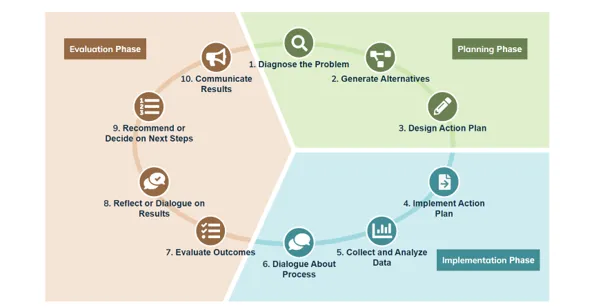
Note. This graphic provides an overview of the main stages of the Applied Improvement Project Model, and the steps in the model were taken during the Advanced doctoral courses. The shaded areas are like the three phases indicated, the circles are like the 10 steps indicated, and the line between the icons is like the linking between steps in the corresponding phase. Retrieved from https://media.capella.edu/CourseMedia/edd8522element20223/wrapper.asp. Not publicly available.
https://media.capella.edu/CourseMedia/edd8522element20223/wrapper.asp. Not in the public domain.
Using the AIP model, a systematic approach to diagnosing and managing the organizational problem will be used. Step 1 of the AIP model serves as the main focus of the signature assignment, as deals with problem diagnosis. Step 1 is used to define the root cause and underlying problem. To build a complete overview of the problem, its causes, and likely impacts. The diagnostic results will inform the next steps in the AIP model. The application of the model in the Doctor of Education program facilitates the use of organizational problem management and the linking of the AIP model with Advanced Doctoral Courses.
Preliminary Site Information
The Lions Clubs International Foundation (LCIF), based in Oak Brook, Illinois, USA, is an international, non-profit organisation. The LCIF is dedicated to increasing youth’s access to quality education (Lions International, 2025). The LCIF is also active in other areas internationally, such as health improvement, disaster management, and youth development programs. Lions Quest is one of the larger programs for youth, and a Social Emotional Learning (SEL) program that is administered in partnership with thousands of schools globally (Lions Quest, 2025). There is a history of SEL at this site, but it comes from a very large initiative- grades-wide- all concerned with dealing with rising issues of bullying, chronic absenteeism, and student academic performance (Lions International, 2025). SEL is intended to boost students’ social skills and their emotional intelligence, therefore improving their academic performance. School district and site principals’ expectations are to prioritize emotional regulation, decision-making, and building positive peer relationships. Stakeholders are not hiring teachers to teach the SEL program. In the absence of the SEL program, the student absenteeism rate was also linked to academic performance and was higher.
The LCIF is a support for schools in so many contexts. Schools usually have between 300 students and 1,500 students and vary significantly in composition from area to area. In addition, students are typically from the same racial, ethnic, cultural, and linguistic backgrounds as their surrounding community. The organization provides education to students of various ages and backgrounds, such as elementary, middle, and high school students. The organization has teaching staff to implement the SEL program for high school students. The majority of schools have 25-75 teachers trained in Lions Quest. Lions Quest schools are strategically placed across urban, suburban, and rural settings, discreetly. The potential for student academic success is strengthened by SEL programs like Lions Quest because many schools report concerns about behavior, bullying, and mental health, creating a positive school climate (Lions International, 2025). Through the implementation of Lions Quest, these schools with LCIF partnerships create an environment that is conducive, safe, inclusive, and academically supportive to students from all backgrounds. The website promotes the idea of supporting SEL programs to enhance student achievement by establishing a positive school culture that promotes diversity and inclusiveness among students.
The program’s emphasis is on closing educational achievement gaps as well as enhancing long-term academic success rates. SEL skills like self-regulation and cooperation can be taught early, leading to the development of social skills and a better ability to sustain success in school. The program educates students to be successful in life, both personally and academically. The programme is an inclusive one, with students from different economic backgrounds involved, and particularly assisting disadvantaged population groups.
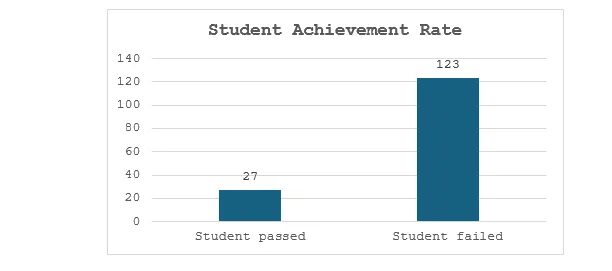
The site has a significant number of teachers who are required to provide teaching in the SEL education programs. But the teachers’ inability to meet the needs of the students due to the teacher shortage affects their academic achievement. The site has identified multiple problem areas that hinder the ability to provide students with an SEL program, affecting the success rate. The concerns with the practice are that there are not enough staff to deliver SEL with students, which has a connection to their academic outcomes. Student achievement is currently at 5% with a benchmark of 11%, and there is a need for effective efforts to improve the academic achievement of the students. The problem calls on the site to offer quality SEL programmes to reduce the low rate of educational achievement among students.
Role in or Relationship with the Organization
The applied researcher’s unique contribution is to be engaged in the Lion Quest program the organization has established for teaching SEL to students. The title is the volunteer who takes part in the Lion Quest Program to raise awareness among students about the SEL program. Applied research is linked to the organization and is in charge of planning, implementing, and evaluating SEL for students in the school. In addition, the researcher also plays a role in conducting student support services, including SEL programs. The applied researcher believes that these efforts are part of the mission of increasing the rate of student achievement. A hierarchical structure of the site is created on the basis of the involvement of the board members, where all staff can express their opinions about the management of the organization’s issues.
The applied researcher has a critical role to play in the problem of staff shortages impacting the delivery of SEL by pointing out the gaps in the delivery of SEL programs due to a lack of staff. Transitioning SEL practice into curricula that has less staff is difficult to develop. Evaluation of SEL delivery models, and calling for more staff to support SEL implementation, is required. The applied researcher role is directly tied to improving student academic achievement and well-being through supporting SEL programs even in the absence of support staff.
Potential conflicts of interest may arise due to financial difficulties, personal issues, and academic struggles. This occurs when the researcher’s financial interest in the research results is present. For example, the funding request for SEL services could lead to less funding for educational programs. The applied researcher’s interest in the ownership of shares in the organization that benefits from the research may impact objectivity in conducting research. The applied researcher might have biases in his/her research decisions due to personal contact. If applied researchers study individuals with familial or personal ties, personal relationships can impact the research results and/or decision-making. An academic conflict arises when the researchers are pushing for money to do the education session. Researchers may fall into the danger of not valuing academic concerns if they are not appropriately implementing SEL. The pressure to produce positive results can be a motivation for the researcher to present biased data or to manipulate the data.
Using effective approaches to mitigate potential conflicts of interest is pertinent. Firstly, declarations of all financial, personal, and academic interests before commencing research will assist in avoiding personal influence on research. Raising the funds needed to launch the SEL program can also lead to support and help to reduce financial risks. Also, the revelation of personal relationships and affiliation with the site leadership mitigates the risk associated with personal affiliation. Secondly, do not enlist the help of members of the immediate family and close friends to ensure research integrity. To mitigate the risk that threatens the integrity of the research, it would be helpful if third parties are involved who have no influence on the project. Transparency across the board with the third parties will provide accurate data. Third, the application of stringent methods of data gathering, data analysis, and reporting lessens researcher bias in the findings. The analysis will be conducted via protocols such as data auditing by people not involved with the project to ensure transparency and credibility of the findings.
Figure 2
Student’s Achievement Rate
Additional data also showed that organizational performance issues were related to a lack of training in designing SEL programs. Hence, the dilemma of a lack of training to provide SEL programs to the staff and a lack of trained educators contributes to poor academic outcomes for students. Inadequate coordination occurs due to a lack of collaborative resources, which results in the lack of SEL curriculum program development for the students (Project manager, personal communication, September 15, 2024). The site has developed an SEL program for the students’ and emotional intelligence. Improvements need to be made in training in conducting SEL programs. Figure 3 shows the percentages of teachers who are proficient in developing the SEL curriculum.
Potential Root Causes
Additional data also showed that organizational performance issues were related to a lack of training in designing SEL programs. Hence, the dilemma of a lack of training to provide SEL programs to the staff and a lack of trained educators contributes to poor academic outcomes for students. Inadequate coordination occurs due to a lack of collaborative resources, which results in the lack of SEL curriculum program development for the students (Project manager, personal communication, September 15, 2024). The site has developed an SEL program for the students’ social skills and emotional intelligence. Improvements need to be made in student academic performance by having teacher training in conducting SEL programs. Figure 3 shows the percentages of teachers who are proficient in developing the SEL curriculum.
Organizational Context Analysis
The Problem and History
The Organization’s Mission and Values
Organizational Factors that Support or Hinder the Improvement Project
Assumptions of the Organizational Issue by Administrators and Stakeholders
The Organization’s Political, Social, and Economic Culture
Scope and Significance of the Organizational Issue
Number of People
Impacted by the Project
Impact on the Organizational Systems
Impact on the Organization as a Whole
Links to Organizational Goals and Objectives
Implications (s) Beyond the Organization
Theory of Action
Problem Statement
Proposed Actions/Interventions
Table 1. Proposed Actions/Interventions
Potential Solution/Intervention | Root Cause Solution/Intervention Addresses |
If Propositions and Then Statement
Organizational Beliefs and Assumptions
Proposed Approaches to the Problem of Practice
AIP Preferred Approach
Alignment of the Doctoral
Project to Your Specialization
Rationale for the Project
Site Permission
References
Huynh, V. S., Giang, T. V., Nguyen, T. T., & Dinh, D. H. (2021). Exploring the challenges of social-emotional learning integration in secondary schools: A phenomenological research in Vietnam. Psychology Research and Behavior Management, Volume 14, 621–635. https://doi.org/10.2147/prbm.s300748
Lions International. (2025). Youth. Lionsclubs.org. https://www.lionsclubs.org/en/give-our-focus-areas/youth
Lions Quest. (2025). Program catalog. Lionsquest.org. https://www.lions-quest.org/wp-content/uploads/2015/10/ProgramCatalog.pdf
McCoy, D. C., & Hanno, E. C. (2023). Systemic barriers and opportunities for implementing school-based social–emotional learning interventions in low-income and conflict-affected settings. Frontiers in Psychology, 14. https://doi.org/10.3389/fpsyg.2023.1011039
Shengyao, Y., Xuefen, L., Jenatabadi, H. S., Samsudin, N., Chunchun, K., & Ishak, Z. (2024). Emotional intelligence impact on academic achievement and psychological well-being among university students: The mediating role of positive psychological characteristics. BioMed Central Psychology, 12(1). https://doi.org/10.1186/s40359-024-01886-4
Stevenson, N. A., VanLone, J., & Barber, B. R. (2020). A commentary on the misalignment of teacher education and the need for classroom behavior management skills. Education and Treatment of Children, 43(4), 393–404. https://doi.org/10.1007/s43494-020-00031-1
Appendix A. Gap Analysis
Process or Activity that Affects Performance | Expected Performance (A) | Current Performance (B) | Performance Gap (A minus B) | Effect of Gap on Organization |
Lack of optimal allocation of financial resources | 90% of the financial resources required for delivering the SEL program | 5% of the resources are not sufficient to deliver SEL | 85% of the resource constraints bring challenges in delivering SEL to students | Poor student academic outcomes |
Lack of staff collaboration | 90% of the staff collaborated to implement the SEL program | 10% of the staff are collaborating to implement the SEL program | 80% lack of staff collaboration hinders the SEL program implementation | Lower student achievement rate. |
Lack of a feedback system | 80% feedback will be provided on the SEL program implementation | No feedback provided (0%) | 80% of teachers do not get any feedback regarding the SEL program | Ineffective student learning environment |
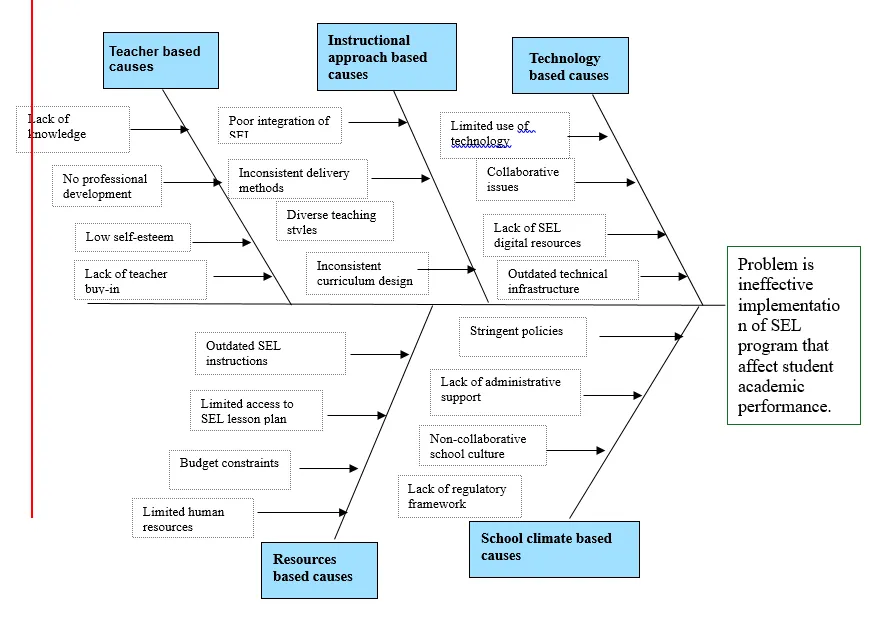
Appendix B. Ishikawa Root Cause Analysis