
Student Name
Capella University
EDD FPX 8020
Professor Name
Submission Date
Teaching Case Study
Change in organizations in higher education is a very complex yet necessary process in institutions that want to increase academic opportunities and address changing needs of the community. Some of these changes, including the implementation of baccalaureate programs in the community college, are indicators of the move towards greater access, workforce, and institutional development (Ghasemi et al., 2023). The dynamics, the challenges, and the leadership methods of such transitions are crucial to sustainable success (Khalil, 2024). The paper below concentrates on a scenario of two community colleges that are facing a transition into four-year degree programs by examining how the transition can be viewed in terms of learning organization disciplines, disabilities, and systems archetypes. Moreover, change management strategies, models to inquire about continuous improvement, and realistic suggestions to lead the organization development in the future will be the center of the debate.
Case Synopsis
In the case study, organizational transformation in two community colleges in Florida (Transition College and Conversion College) is explored, where both colleges sought authorization to deliver baccalaureate degree programs due to the changing workforce and educational needs. Florida Community colleges were initially established as a way of delivering inexpensive associate-level education and vocational education to the local communities. But changing economic times, labor market demands, and state policies led to the implementation of the community college baccalaureate (CCB) program that allowed some colleges to expand their institutional purpose by providing limited bachelor’s degrees. The research problem is how the two institutions successfully dealt with such a large-scale change when dealing with accreditation, governance, and cultural issues that arose during the change from two-year to four-year degree provider institutions.
At Transition College, change was sought by the leadership to solve the workforce problem in areas like nursing and teacher training. The president was the change champion who organized a holistic process, which included the board of trustees, executive cabinet, faculty members, and partners in the local community. Market analysis and surveys of employers were performed by institutional leaders to find out the skills gaps and to prove the necessity of introducing new programs. Basing their actions on the conceptual framework of the Kotter eight-step model, the leadership focused on urgency creation and coalition building, and clear department-wide communication (McKinney and Morris, 2010). Significant impediments were the lengthy state approval process, accreditation compliance with the Southern Association of Colleges and Schools (SACS), and faculty concerns related to increased workload and mission redirection.
Conversion college took a similar route, but faced even more opposition from regional universities and financial setbacks with accreditation requirements. Professors expressed their concern that a shift to baccalaureate-level education was going to water down the original intent of accessibility and affordability (McKinney and Morris, 2010). The two colleges had to engage in a great deal of organizational rearrangement, modernization of libraries and facilities, as well as faculty members possessing a terminal academic degree in order to meet the expectations of accreditors. Through mutual planning and active and consistent involvement, the two colleges attempted to integrate institutional innovation with the established values of community services and provide important input in understanding adaptive change processes in the community higher education sector.
A Systems Lens – The Four Core Disciplines
Personal Mastery
Personal mastery is the field of study that focuses on individual development, self-understanding, and the dedication to self-improvement. In the institutions of Transition College and Conversion College, senior leaders and especially the presidents demonstrated the discipline by a strong commitment to the progress of their institutions and professional ethics. There was self-direction and strong resilience in leadership, which encouraged others to achieve excellence in an uncertain transition. There was, however, a disconnect between certain faculty and staff who did not have adequate levels of professional development or knowledge of the overall vision, and this contributed to disparities in the level of commitment.
Inadequate support to facilitate the development of personal mastery in different departments may be due to limited time to practice and insufficient support to assist the faculty to develop their own mastery (Ghasemi et al., 2023). Leadership-based learning is used to demonstrate the progress of colleges, though it needs more institutional investment in faculty empowerment, training, and mentoring. The personal mastery of each and every level of the organization would help in developing a more adaptive culture, help eliminate change resistance, and help maintain momentum towards long-term change even within the new baccalaureate model.
Mental Models
Mental models are distinct assumptions and perceptions that are ingrained to influence comprehension and action. In both these colleges, a clash between innovation and tradition was created by the divergent mental models about the mission of the community colleges. The introduction of four-year programs into an open-access, two-year educational mission was perceived as mission drift by the faculty members who felt that their college could be put at risk of no longer being who they were. Administrative leaders, on the other hand, regarded the expansion as a requisite progression that was in tandem with workforce and economic advancement requirements.
The lack of open forums at an early stage of the process deprived a chance to question an old assumption or to harmonize views among stakeholder groups. The study by Weatherton et al. (2024) corroborated the argument that unresolved mental models and strongly ingrained institutional beliefs tend to act as change inhibitors in the context of higher education, as stakeholders find it difficult to balance old values with new organizational missions. With time, the leadership communication initiatives (meetings, newsletters, presidential updates) started to alter the group attitudes to the new course. The success of such transformation of mental models would be enhanced through the use of structured dialogue, reflection, and inter-departmental work that would foster inquiry and the reevaluation of long-established assumptions about institutional purpose and educational equity.
Team Learning
Team learning entails coordinating group activities to increase group capabilities of solving problems and mutual development. Both colleges have established a lot of committees, task forces, as well as planning groups to organize accreditation, curriculum development, and compliance with policies. The information exchange and the sharing of decision-making were supported by the collaborative structures. Leadership created a culture of appreciation of collective input, especially in the community and board. Paulus (2023) further pointed out that team learning is a powerful concept in organizations that thrives when leaders promote psychological safety, thus facilitating free discussion and joint problem-solving activities. Yet, this did not help the team learning as the communication was not flowing equally between the administrative and instructional levels. Through fostering genuine collaboration, the two institutions can turn task-based committees into learning communities that constantly evaluate the results, exchange knowledge, and respond to the challenges. Long-term team learning would contribute to instilling organizational agility and building group competence in the course of the continual accreditation and program development activities.
Shared Vision
Shared vision is a discipline that focuses on building a sense of purpose that brings the members together. Leadership in both institutions developed a vision of increasing access to education and meeting the demands of the region on its workforce by developing new baccalaureate programs. The role of the presidents was critical to expressing the reason behind change, through campus-wide meetings, community forums, and written messages, to create enthusiasm and coherence. There was constrained collective ownership due to limited early participation of faculty in vision formation. Zasa and Buganza (2022) stipulated that a shared vision is genuinely created when the members of the organization are actively involved in its design, which results in greater commitment and alignment, and emphasized that inadequate engagement of the faculty at the initial stage of the process may water down ownership and hinder the achievement of lasting change. Such a strongly held collective vision would entail long-standing discussion, inclusion, and enforcement of the institution’s policies. Installing such a common purpose into the organizational culture would ensure long-term alignment and collective responsibility for transformative educational outcomes.
A Systems Lens – Organizational Disabilities and Systems Archetypes
The systems and patterns of organizational disabilities described by Senge are the patterns that are systemic and behavioral, and hinder the learning processes and flexibility within an institution. The main disability that was dominant in Transition College and Conversion College was that individuals were more focused on the individual sense of self-accountability and not on the collective cause. The resistance of the faculty to the transition manifested in an organizational narrow-minded vision where most of the instructors saw the introduction of bachelor’s programs as a hindrance to the 2-year college brand, instead of a move towards enhancing the institution.
Such a type of limited thinking minimized cooperation and innovation in problem-solving. The second disability that happened is known as the myth of the management team, in which top management was looking outwardly with the appearance of coexistence, and internally, the team members were experiencing ambivalence about how big the change would be and how it would start. Open communication between the stratification levels was absent, which entailed stifled, straightforward thoughts about the workload, danger, and sustainability. A study by Yang et al. (2022) showed that open communication and the ability to enquire into underlying assumptions concerning organizational learning are blocked by defensive routines. Excessive focus on short-term processes, including state approval dates or accreditation audits, strengthened reactive planning as opposed to strategic planning. Such barriers can be best broken through the promotion of open communication, and interdepartment work, and system awareness to make individuals see how individual work is tied to institutional development.
Systems Archetypes
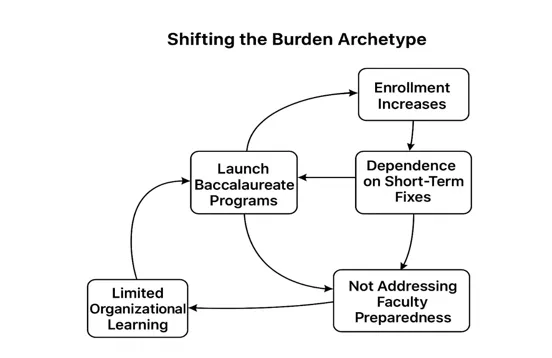
The case is closely associated with the archetype of systems that shift the burden, whereby short-term solutions are enforced to handle the problem at hand and unknowingly compromise the basic long-term solutions. The two college leaderships aimed at replacing the anticipated state expectations and demands of the workforce by introducing new baccalaureate programs fast. Though this was in response to the demands by outside stakeholders and also gave a perception of responsiveness, the move took the focus off more systemic problems like readiness of faculty, infrastructure, and culture adjustment. This led to short-lived compliance, overlooking the necessity of long-term capacity building.
With time, overdependence on external consultants, policy compliance measures, and formal task forces were symptomatic remedies, which created apparent advances but failed to develop institutional self-sufficiency. The symptomatic solution in the identified archetype was to pay attention to documentation, accreditation, and PR to prove the progress (Awoyemi et al., 2023). The inherent solution, which would have entailed the investment of faculty development, participatory leadership, and long-term learning in the organization, got less attention because of time and resource limitations. What came as the unintended consequence was a loop of reliance on short-term solutions, hence constant stress, miscommunication, and internal opposition.
The archetype identified would be represented in a systems map with a reinforcing loop where an action by the leadership (immediate response to external pressure) would provide temporary relief, but over time, it would increase the erosion of the organizational learning capacity. The unrealized potential of systemic improvement by collaboration, capacity development, and shared learning would be depicted in the balancing loop. The identification of the systems archetype highlights the significance of working on underlying causes instead of using compliance-based solutions. To shift towards sustainable change, leaders would need to strike a balance between urgency and depth in order to create a culture of prioritizing long-term institutional learning over short-term containment of problems.
Change Management Strategies for the Community College
In the Community College setting, the management of change has to incorporate, as a critical part of the process, the ability to think critically and build systems-oriented leadership to overcome the latent obstacles to organizational change. A number of critical thinking tools can help the stakeholders to demystify issues and coordinate efforts towards sustainable solutions. Thinking (purpose, question, and information) as a three-part analysis can offer an analytic framework to discover the underlying cause of institutional pullback. Administrators need to establish the mission behind the transition to baccalaureate programs, ask critical questions regarding the faculty preparedness and community demands, and gather information to justify the right decisions (Rusmin et al., 2024). The assumptions, implications, and perspectives of the thought model also contribute to assisting leaders in becoming aware of untested assumptions regarding community college missions and expecting the long-term outcomes of policy changes (Rusmin et al., 2024). The application of intellectual standards like clarity, accuracy, and relevance promotes open lines of communication between departments and strengthens the use of evidence-based decision-making in the process of restructuring an organization.
The four steps of the change process proposed by Stroh, which are to establish a foundation to change, develop commitment, maintain transition, and design new capacity, provide a good blueprint to enhance the strategic planning process in the Community College. At the foundation level, the executive level needs to build a common knowledge about institutional objectives through clarifying the reasons the baccalaureate programs exist and creating congruence between the faculty, administrative, and external stakeholders. The commitment step entails creating ownership by means of cooperation and ongoing communication to foster internal opposition and generate excitement towards innovation. The viability of transition depends on the continuation of the momentum through tracking progress, acknowledging success, and updating policies in response to emerging challenges such as staffing and budgeting limitations (Mouazen et al., 2023). The last stage is embedding new capacity, which makes the organizational learning institutional through a process of continuous professional development, leadership training, as well as adaptive governance. The model by Stroh can help administrators to establish a culture of reflection, systems thinking, and collaborative problem-solving that are the key components of success in the long-term of the transition to providing four-year degree programs.
Inquiry Model for the Next Phase of Organizational Improvement
Appreciative Inquiry (AI) model presents a strengths-based strategy on how to steer the Community College towards the next stage of development. Through the discover, dream, design, and destiny stages, the leaders of colleges will be in a position to promote an inquiry culture that builds on what has already been attained within the institution and contemplates new possibilities. The leaders and faculty decide on effective practices in the baccalaureate transition, such as good faculty recruitment and community engagement, in the discover stage. The ‘dream’ phase motivates the imaginative process of the desired future condition, i.e., augmented academic services and an improved support system among the students.
The cross-functional teams collectively formulate feasible action plans during the design stage to improve the strength of governance, resource allocation, and interdepartmental collaboration. The stage of destiny continues the motivation since it provides the faculty and staff with the power to push innovations and measure the progress of the innovation through reflective discourse and performance measures. Cho and Ardichvili (2024) conclude that AI enhances transformative organizational change due to the fact that the model enhances the present strength and gives a feeling of common investment in a preferred future, leading to heightened engagement and innovation at the institutional levels. Having a long-term orientation about collective learning and empowerment, the Community College can have a progressive culture dynamic based on changes based on academic excellence and responsiveness to the community. Using the AI model ensures continual learning, inclusivity, and alignment of techniques of every person within the institution.
Recommendations for College Leadership
To enhance alignment with the institutional mission of accessible and high-quality education, college leaders need to focus on open communication, shared governance, and decision-making that is evidence-based. Building joint leadership councils consisting of faculty, administrators, and community partners can be effective in promoting common ownership in the baccalaureate transition. The involvement of faculty and innovation will be supported by strategic investment in professional growth that aims at instructional excellence and organizational learning (Damkuviene et al., 2023). The deployment of data-informed planning systems will make sure that academic growth is in tandem with labor demands and student achievement criteria. The vision of the college being regional service and responsive can also be enhanced by strengthening community partnerships. By aiming to be more inclusive and respectful in leadership practice, morale and trust will be maintained among the stakeholders (Phillips et al., 2025). Based on a dialogue, reflection, and accountability-driven continuous improvement framework, the values of integrity, collaboration, and lifelong learning of the college will be maintained in order to lead to sustainable growth of the organization.
Questions
- What is the best way community college leaders can consider the culture of collaboration and shared learning to enable faculty empowerment and institutional change in response to major change initiatives?
- How can the organization both be financially sustainable and provide equitable access to new academic programs and remain committed to the mission of serving communities and providing educational opportunities?
- What can be done to incorporate the concepts of systems thinking and ongoing inquiry into the daily decision-making process to make sure that even at the organizational level, the process of improvement is proactive and responsive to new challenges?
Conclusion
Community colleges to baccalaureate institutions is a significant change in the landscape of higher education that needs to be approached strategically and in a collaborative way. Successful organizational change requires resistance barriers to be overcome, a convergence of institutional policies as well as the development of a common vision among stakeholders. The use of systems thinking and learning organization disciplines will help a leader to discover the root of the problem and ensure sustainable solutions. Strong stakeholder engagement can further support the transition by encouraging shared responsibility and consistent progress toward institutional goals. The ongoing research and evidence-based planning contribute to flexibility and improve compliance with the college mission and values. With open communication, participative governance, and evidence-based practices, community colleges will be able to attain significant and sustainable organizational change.
References
Awoyemi, O., Attah, R. U., Basiru, J. O., & Leghemo, I. M. (2023). Strategic integration of media and public relations to address communication barriers in organizational reputation management. Open Access Research Journal of Multidisciplinary Studies, 6(1), 076–085. https://doi.org/10.53022/oarjms.2023.6.1.0035
Cho, H., & Ardichvili, A. (2024). Appreciative inquiry: An integrative review of studies in three disciplines. Human Resource Development Review, 23(3), 1–8. https://doi.org/10.1177/15344843241256156
Damkuviene, M., Valuckiene, J., Balciunas, S., & Petukiene, E. (2023). Education professionals’ cooperative learning for the development of professional capital. Sustainability, 15(14), e10972. https://doi.org/10.3390/su151410972
Ghasemi, S., Bazrafkan, L., Shojaei, A., Rakhshani, T., & Shokrpour, N. (2023). Faculty development strategies to empower university teachers by their educational role: A qualitative study on the faculty members and students’ experiences at Iranian universities of medical sciences. BioMed Central Nursing, 23(1), e260. https://doi.org/10.1186/s12909-023-04209-0
Khalil, A. G. (2024). Integrating sustainability into higher education challenges and opportunities for universities worldwide. Heliyon, 10(9), e29946–e29946. https://doi.org/10.1016/j.heliyon.2024.e29946
McKinney, L., & Morris, P. A. (2010). Examining an evolution: A case study of organizational change accompanying the community college baccalaureate. Community College Review, 37(3), 187–208. https://doi.org/10.1177/0091552109351185
Mouazen, A. M., Lara, B., Abdallah, F., Ramadan, M., Chahine, J., Baydoun, H., & Bou Zakhem, N. (2023). Transformational and transactional leaders and their role in implementing the Kotter change management model ensuring sustainable change: An empirical study. Sustainability, 16(1), 16. https://doi.org/10.3390/su16010016
Paulus, P. (2023). The role of psychological safety in team communication: Implications for human resource practices. Golden Ratio of Mapping Idea and Literature Format, 3(2), 156–166. https://doi.org/10.52970/grmilf.v3i2.399
Phillips, B. N., Fleming, A. R., Kwiatek, S. M., Riesen, T., Emery, C. K., Langone, A., Gripentrog, L., Garside, M., Cardis, J., Snyder, A., Taylor, D. L., Allen, M., & Harward, E. (2025). Data-informed collaboration in transition services: A model for improving outcomes. Journal of Vocational Rehabilitation, 63(2), 160–170. https://doi.org/10.1177/10522263251356271
Rusmin, L., Misrahayu, Y., Pongpalilu, F., Radiansyah, R., & Dwiyanto, D. (2024). Critical thinking and problem-solving skills in the 21st century. Journal of Social Science, 1(5), 144–162. https://doi.org/10.59613/svhy3576
Weatherton, M., Ko, M. E., Nichols, E. L., Krishnan, S., & Faber, C. (2024). All in: Understanding and motivating stakeholders to create an equitable culture of student success. Life Sciences Education, 23(4), e10. https://doi.org/10.1187/cbe.24-02-0065
Yang, Y., Secchi, D., & Homberg, F. (2022). Organizational structure and organizational learning: The moderating role of organizational defensive routines. Journal of General Management, 47(4), 259–270. https://doi.org/10.1177/03063070211038922
Zasa, F. P., & Buganza, T. (2022). Developing a shared vision: Strong teams have the power. Journal of Business Strategy, 44(6), 415–425. https://doi.org/10.1108/jbs-04-2022-0065